
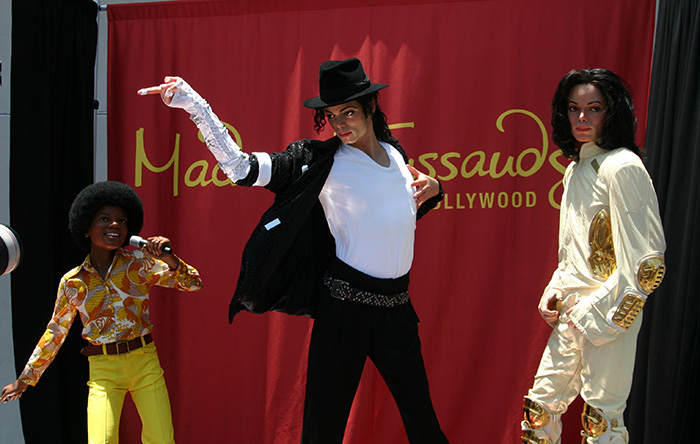
Los Angeles Tribute to Michael Jackson
This Los Angeles Tribute to Michael Jackson, the World’s Greatest Entertainer and a record-breaking humanitarian, provides more context for that unique human being. To understand what drove much of his artistry and mystery without tabloid sensationalism, consider a series of unfortunate events that contributed to the tragedy of Michael’s ever-changing looks.
Much has already been said about the troubles of his relationship with his family from a child through a young adult. It bears repeating the emotional trauma Michael suffered from skin-related diseases.
Having prodigy talent and urging from his father, Michael developed his most soulful canon of work from age 6 in Gary, through the Motown and Philadelphia International years and Off The Wall album at age 21. But if we’re keeping it real, Michael Jackson would not have blossomed into a world phenomenon had he not moved to Hollywood.
After the Off The Wall album, Hollywood encouraged his Peter Pan Persona and amplified discussion about his changing looks that were easy to recognize and impossible to understand at the outset. When viewing Michael, we are only blind men feeling a piece of the camel. In his 40s, Michael finally grew confident enough to admit that severe acne, beginning as a teenager and for many years into adulthood, damaged his self-image.
In July 2009 Michael’s dermatologist, Dr. Arnold Klein, confirmed that Michael’s acne was so severe that it required medical treatment and surgeries. He also suffered from Lupus. While filming a Pepsi commercial with his brothers in January 1984, Michael suffered 2nd and 3rd degree burns to his scalp.
Due to intense pain from the burns, which required surgeries, he developed an addiction to prescription painkillers. Never able re-grow hair in that large area, Michael wore wigs for the rest of his life.
Sometime around the debut of Thriller in Fall 1982, Michael began evidencing the skin pigmentation disorder Vitiligo to larger degree. At that time Cicely Tyson’s fashion designer told her that Michael was showing white spots on one of his hands. In an effort to conceal it, Michael requested the design of what became his trademark – the sequined glove. Vitiligo often appears as spots or lesions on the hands and face, and there is scientific evidence suggesting that it is caused by a combination of autoimmune, genetic, and environmental factors. There is no cure for it and Michael’s autopsy report confirmed that he had Vitiligo.
Vitiligo is particularly devastating to a black person who witnesses the skin disorder destroying their self-identity. Many blacks experiencing the early stages of Vitiligo use heavy makeup to even out skin color. When depigmentation becomes a majority of the skin, black patients face a traumatic decision:
• walk around in total brown body make-up
• walk around as a spotted human being
• begin bleaching to even out pale white pigmentation
With either choice during Michael’s lifetime, they become the subject of written abuse, verbal abuse, and often, discrimination.
His color dramatically changed over 4 years between the Thriller and Bad albums, as the skin disorder spread. At times he wore masks to hide the advancing Vitiligo on his face. Given the skin disorder was spreading across his entire body, it did not matter whether he finally used bleaching treatments. It did not matter that we was proud to call himself “Black” and to be called “Black.” Nature decided that large patches of his skin would unalterably become pale white.
Many young people don’t realize that between 1983-1990, everything Michael Jackson did or said was reported on TV, radio, newspapers, and magazines daily or weekly. In that decade, Michael endured more media scrutiny than the President, Queen of England, and the Pope. To quote one of his friends, Kenny Rogers, “I wouldn’t wish that level of media attention on anyone.” Isn’t it likely, that the lack of a normal childhood, severe acne, Vitiligo, Lupus, a burned scalp that produced a painkiller addiction combined with unprecedented media scrutiny contributed to the Body Dysmorphic Disorder? That is what triggered excessive plastic surgeries.
Complicating matters, people with Body Dysmorphic Disorder are in denial about it and rarely seek psychiatric treatment for the disorder.
Anyone with fame and fortune is bound to manifest eccentricities that are exaggerated because tabloids who sold record numbers of magazines and TV programs who attracted record viewership whenever they mentioned “Michael Jackson” as a lead item. Hearsay and innuendo masqueraded as the truth.
Despite his troubles, Michael shared his vision of a world where it should not matter whether you were Black, White, or anything in between. That is why Michael in pale white pigmentation, celebrated being African American without putting down other races. And yet he portrayed sexy women and men of all colors in his videos. To cite one example, he evoked a typical Brotha’s pride cruising for girlies with Chris Tucker and simultaneously gave props to long-time friend Marlon Brando in the same You Rock My World video.
To cite another example, Michael used his depigmentation to far greater effect by denouncing racism in the video Black or White. His celebrated friendship with Elizabeth Taylor was real and lasted until the end of his life. No wonder a rainbow of people celebrate his life and music today.
Tabloid media and millions of haters owe this troubled man of the 21st century a mega-apology concerning his changing looks and understanding of how he contracted an addiction to prescription drugs.
Michael Jackson’s entertainment genealogy is unparalleled. But to understand that part of his life, one should first acknowledge the teachers who taught his teachers. Louis Jordan, Big Joe Turner, Little Richard and countless Gospel singers set the stage for Michael’s mentors and inspirations: Joe Jackson (his dad and 1st manager), James Brown and Jackie Wilson.
It is also well known that Berry Gordy, Diana Ross, Stevie Wonder and the Motown Family combined with Quincy Jones and Rod Temperton, took him to finishing school as a lyricist and music producer.
Michael’s genius as a dancer was to use his influences from James Brown and Fred Astaire as a foundation, then layer both popular and professional dance moves from his choreographers Jeffrey Daniel, The Electric Boogaloos, Michael Peters, Asia Dickens, Fatima Robinson, and Travis Payne on top. Michael’s prodigy-level talent and perfectionist drive girded him to mastery. Uniquely coupling his talents with A-List connections in the entertainment industry, the Michael Jackson canon of stage and video performances became icons for past, present, and future generations to marvel and study.
As Bob Davis, publisher of Soul-Patrol.com said, “Its impossible to imagine the unique set of circumstances required to produce another entertainer like Michael Jackson.”
As a measure of popularity, our capitalist society races to answer a burning question, “Who was the most popular entertainer” by measuring who sold the most albums, had the most #1 hit records, sold more concert tickets, and sold more merchandise. From that commercial perspective, Michael Jackson’s only peers were Elvis Presley and the Beatles.
I take a different view on the popularity question. In their stratosphere, it does not matter who sold more albums, #1 records, concert tickets, and merchandise. Instead, I argue that artistic influence matters more because it lasts longer and wider.
From age 6 to 50, Michael Jackson’s body of artistic work influenced more people and performing artists than any other person on earth. From Harlem to the Kremlin, from Borneo to Bahrain, Michael’s music, dancing, and stage artistry are beloved. Even before his death, he inspired a voluminous number of fan video mash-ups. And based on the acts of today’s most successful entertainers under 30, Michael’s artistic influence is certain to last decades longer.
Hip-Hop icon Biggie Smalls recorded with Michael. The biggest Neo-Soul-Pop stars of today such as Usher, Mariah Carey, Beyonce’, Justin Timberlake, Britney Spears, Chris Brown, Ciara, Fergie, will.i.am, Kanye West, Akon, and Ne-Yo are inspired by Michael’s vocals, dance moves and showmanship. People of all ages worldwide still dance to songs like Billie Jean, Off The Wall, and Rock With You and parrot the lyrics of ABC, Thriller and Man In The Mirror and his other music.
On his path to becoming the World’s Greatest Entertainer, Michael Jackson’s only entertainment talent peer was Sammy Davis, Jr., the vocalist, tap dancer, comedian, impressionist, musician, and actor. Sammy opened the Las Vegas Strip and Miami Beach nightclubs for all entertainers of color to perform. Recognizing the doors opened by Sammy Davis, Jr., Michael publicly thanked Sammy, as you see in the video below. Similar to Sammy in many ways, Michael Jackson’s package of entertainment talent was that of vocalist, innovative dancer, songwriter, producer, actor, and the main character in an animated TV series and at Disney theme parks.
Perhaps the biggest difference between the two child-turned-adult stars was the timeframe. Sammy started professionally in the 1940s and peaked in the 1960s. Michael started in 1964, then became a major recording artist from 1968 onwards. Note that 1968 represented America’s biggest milestone date in the transition from the Segregation Era to Integration Era. Thus, Michael, as a member of the Jackson 5, benefited from commercial and artistic boundaries removed by the Civil Rights Movement, Motown, Stax, Atlantic, and many other record labels and artists in the Segregation Era. As it did for Elvis Presley and the Beatles earlier, The Ed Sullivan TV Show, when there were only 3 national TV channels, introduced millions of new fans to a precocious Michael Jackson and his brothers in 1969 and 1970.
The Jackson 5 recorded several modestly successful albums with Motown: Got to Be There (1972), Ben (1972), Music and Me (1973), and Forever, Michael (1975). As lead singer in the Jacksons, Michael and his brothers (minus Jermaine who stayed with Motown) recorded 6 more albums with CBS/Philadelphia International Records from 1976-1984. For more information about those years, see this informative Jackson Five page at Soul-Patrol.com .
In 1979, Epic Records released Michael’s Off The Wall album to critical and commercial success. Though Off The Wall established Michael as a solo star, nothing could prepare him for the orbital success and fame to come next. Thriller was released by Epic Records in December 1982. Michael Jackson elevated to pop culture phenomenon at the Motown 25th Anniversary TV special at the Shrine Auditorium in Los Angeles. When he moonwalked to Billie Jean across the stage in March 1983, 47 million viewers watched in rapt amazement. Afterward, Fred Astaire called him the world’s best dancer. Then, the president of CBS Records (which owned Epic Records), Walter Yetnikoff pressured MTV to begin airing Billie Jean and Beat It or suffer the consequences. These and other media breakthroughs by Michael Jackson, such as the Rolling Stone covers, opened the door for future black music artists to gain mainstream recognition in America.
Michael Jackson garnered even wider acceptance and new fans when he collaborated with Francis Ford Coppola on the $30 million, 17-minute 3-D film Captain EO, which debuted in 1986 at both Disneyland in California and at EPCOT in Florida. In 1987, it debuted at Tokyo Disneyland, and in 1992 at Euro Disneyland outside Paris.
Then there was the January 1993 Super Bowl in Pasadena, California. Michael Jackson was the featured halftime show at Super Bowl XXVII. The performance began with Jackson catapulting up onto the stage as fireworks went off behind him. As he landed on the canvas, he maintained a motionless “clenched fist statue stance”, dressed in a gold and black military outfit and sunglasses. He remained motionless for a minute and a half. The crowd was both cheering and awestruck. Was it really Michael? He then slowly removed his sunglasses, briskly threw them away, and sang Jam, Billie Jean, Black or White and Heal the World. Viewed by 135 million Americans alone, it was the first Super Bowl where TV viewership “increased” during the half-time show.
Michael Jackson’s choreography has become a part of global pop culture from India’s Bollywood to prisons in the Philippines, to the ghettos and kingdoms of the world. Though often imitated, he has never been equaled as an entertainer who effortlessly merged stirring vocals with innovative dance routines, charismatic showmanship, and groundbreaking videos. As if you needed more proof, watch Michael Jackson kill it on his collage of dance routines at the 1995 Music Video Awards.
Sadly, Michael’s public perception after the first trial and dispute with his record company led to a misfire promoting the Invincible album. Had it been promoted as normal and fitting his stature, surely Unbreakable, You Rock My World, Break of Dawn and Whatever Happens with Carlos Santana would have been major hits and the album would have approached 20 million sales worldwide. That misfire took a personal toll on Michael.
Much different than the days when he had to break down color barriers with his Thriller album, Michael Jackson’s Black or White music video simultaneously premiered in 27 countries with an estimated audience of 500 million in 1991. With that groundbreaking foundation, Michael enjoyed a quantum leap in recording success as a solo artist, as measured by sold-out world tours that filled stadiums and these millions of albums sold worldwide:
20M Off the Wall – 1979
109M Thriller – 1982
30M Bad – 1987
40M Dangerous – 1991
20M HIStory – 1995
10M Invincible – 2001
Michael Jackson set the bar for humanitarian acts by an entertainer. He was a long-time contributor to UNCF. Along with Lionel Ritchie, Michael Jackson co-organized the landmark We Are The World record for African famine relief. That experience led him to organize his Heal The World Foundation. While making a comeback at age 42 in 2001, Michael canceled his famous Madison Square Garden concerts to become a major contributor to the 9-11 victims concert in DC. Here’s a memorable example of his kindness worldwide. On September 12, 1987, the Bad World Tour began. By the time it finished on January 14, 1989, Michael performed before 4.4 million people AND invited underprivileged children to watch for free, and gave donations to hospitals, orphanages, and other charities in each country. In fact, he is listed in the Guinness Book of World Records for his support of 39 charities – more than any other entertainer.
One of his greatest acts of charity is little known. The great Rock n’ Roll innovator, Little Richard, was cheated out of royalties on most of his work. So Michael Jackson bought the publishing rights to Little Richard’s music and actually GAVE it to him.
With such an impact on the world of entertainment and unprecedented humanitarian efforts, we should not be surprised by the response in Los Angeles immediately following his death on 25 June 2009. Fans built makeshift flower memorials in front of the $100,000 per month mansion he rented in Holmby Hills, in front of the Jackson Family estate in Encino, and on his Hollywood Walk of Fame star in front of the Chinese Theater. TV media from around the world sent satellite transmission buses to those impromptu historic sites. Leimert Park Village organized a candlelight vigil and its Gallery Plus boutique was among the first to sell Michael Jackson Tribute T-shirts pictured. The GRAMMY Museum in downtown Los Angeles reopened an exhibit that features a collection of Michael Jackson’s iconic wardrobe pieces alongside a video of his GRAMMY performances.
Given the insurmountable logistical issues, Neverland Ranch did not host the Michael Jackson Memorial Service. Instead, on 7 July 2009 his memorial service was held at the Staples Center in downtown LA. On 3 September 2009, his private funeral service was held at Holly Terrace in The Great Mausoleum at Glendale Forest Lawn Memorial Park in Glendale, CA.
We can remember elements of Michael Jackson’s creative process in the This Is It documentary of his last performance preparation that premiered at LA LIVE on 27 October 2009 and on DVD/Blu-ray since 26 January 2010. We can also appreciate the Michael Jackson: A Musical Legacy exhibited at the Grammy Museum in LA LIVE for most of 2010. Video monitors still present footage of Michael Jackson’s appearances at the GRAMMY® Awards. Another exhibit featured an interactive experience that allow fans to dance on a floor of light-up tiles as they mimic his moves in the Billie Jean video.
To paraphrase Michael in closing, he said he wanted to live forever through his music. In death, his iTunes, GooglePlay, DVD, Blu-ray, and CD sales soared to atmospheric heights again and his music touches another generation via YouTube. And as we reflect on his artistic genius, even Michael’s harshest critics would agree that he got his wish.
On 14 December 2010, the album Michael was released featuring this lead single, Hold My Hand with Akon and video produced in LA. On 21 June 2011 Madame Tussauds Hollywood added two classic Michael Jackson tribute figures to the one it debuted on 24 June 2010 as part of the Michael Jackson Experience. For Michael Jackson fans, this is a must-visit attraction.
In 2011, Michael Jackson ONE, a Cirque du Soleil show, still runs in Las Vegas.