
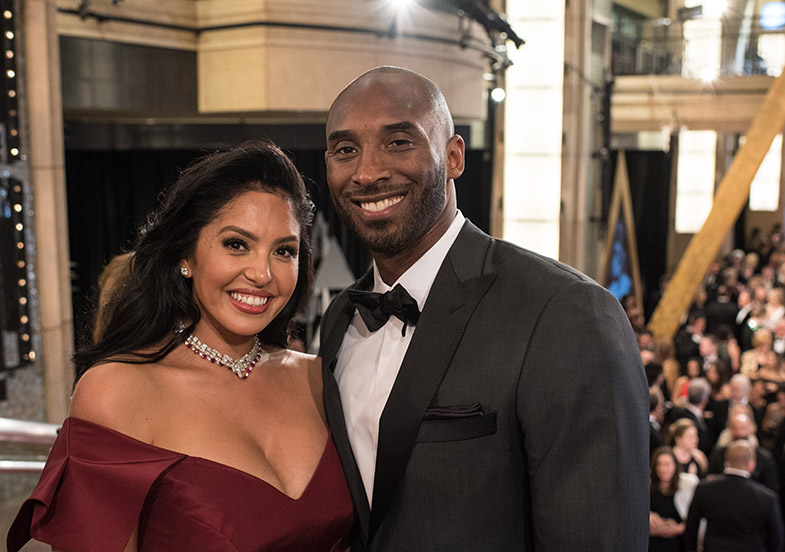
Vanessa & Kobe Bryant on the red carpet of the 90th Oscars® at Dolby® Theatre in Hollywood; credit AMPAS
Black Hollywood Progress
With more People of Color in the Academy of Motion Pictures Arts & Sciences (AMPAS awards “Oscars”), Hollywood Foreign Press Association (HPFA awards “Golden Globes”) and Screen Actor, Director, Writer & Producer guilds, black achievement in Hollywood has accelerated since 2002.
Those new memberships help drive the artistic recognition of African-Americans in Hollywood. In 2002, an African-American won the Oscar for Best Actor a second time and the Oscar for Best Actress the first time. In 2009, a black writer won the Oscar for Best Adapted Screenplay. In 2014, a black director-producer co-won the Oscar for Best Picture. In 2017, black producers also won the Oscar for Best Picture and a black writer won the Oscar for Best Original Screenplay.
In 2018, Kobe Bryant won the Oscar for Best Animated Short Film. In 2019, Ruth Carter won the Oscar for Best Costume Design (Black Panther). Black folks have also won Oscars for production design, original song, sound mixing, animated feature film, and documentaries.
When Cheryl Boone Isaacs became the first African-American President of AMPAS and Paris Barclay became the first African-American to helm the Producers Guild of America in 2013, you could tell could things would come, though not immediately. As late as 2016, the Los Angeles Times reported that AMPAS voters were still 91% white and 76% male.
On the subject of AMPAS membership diversity Cheryl Boone Isaacs said “The Academy is going to lead and not wait for the industry to catch up,” said She backed it up with a multi-year initiative to double diversity AMPAS voters by 2020. Though Isaacs left her leadership role in 2017, Whoopi Goldberg joined AMPAS Board of Directors and AMPAS members grew from 8% People of Color in 2015 to 19% in 2022. Another AMPAS initiative is underway to grow the pipeline of young People of Color in front of and behind the camera. The percentage of AMPAS People of Color should organically grow over the next 5 and 10 years.
Isaacs also launched fundraising for the extraordinaryAcademy Museum of Motion Pictures. Due to the pandemic, its opening was delayed until September 2021. The $480 million Academy Museum features many exhibits honoring many people of color, including those whose opportunities were limited in early Hollywood.
Guild memberships, award nominations & wins, and the Academy Museum are essential ingredients, but progress is occurring because Hollywood studios bow to money-makers. The most important color is Green.
In 1980, Stir Crazy directed by Sidney Poitier and starring Richard Pryor became the first movie directed by an African-American to make $100 million (inflation adjusts to $346 million in 2022). It opened the door for 1980s comedy movies starring Eddie Murphy and Whoopi Goldberg that in turn, made over $100-300 million. They, in turn, opened the door for The Cosbys show to employ more black talent in front and behind the camera while becoming the #1 TV program for many years. The Cosbys success opened the door for Will Smith’s Fresh Prince TV career in 1990 and movie career later.
In 1990, Spike Lee received an Oscar Nomination for Best Director for Do The Right Thing. Given his penchant for calling out Hollywood for racism, however, Spike’s apogee film, Malcolm X, was snubbed for Best Picture and Best Director nominations in 1992. Though he remained a Hollywood outsider for decades, Spike opened more doors for John Singleton, Carl Franklin, Bill Duke, and several others to direct Hollywood feature films that decade.
RELATED: Black Hollywood History
Denzel Washington, Angela Bassett, Morgan Freeman, and others did award-worthy work from 1989-2001. The big break came in March 2002, when the Screen Actors Guild, younger and more diverse than AMPAS membership, presented Halle Berry the Oscar for Best Actress Award, Denzel Washington the Oscar for Best Actor, Sidney Poitier the Oscar for Lifetime Achievement.
Since then, Denzel Washington, Will Smith, Morgan Freeman, Jamie Foxx, Halle Berry, Forest Whitaker, Idris Elba, and Viola Davis have headlined many A-List budget movies. More movies featuring black themes, writers, directors, and producers got better financing. More African-Americans starred in Drama, Sci-Fi, Action, Comedy, and Musical movies and TV programs. Spike Lee, John Singleton, Antoine Fuqua, Steve McQueen, Barry Jenkins, Tyler Perry, F. Gary Gray, Ryan Coogler, Tim Story, and Lee Daniels directed movies that grossed over $100 million box office or won Oscars/Golden Globes.
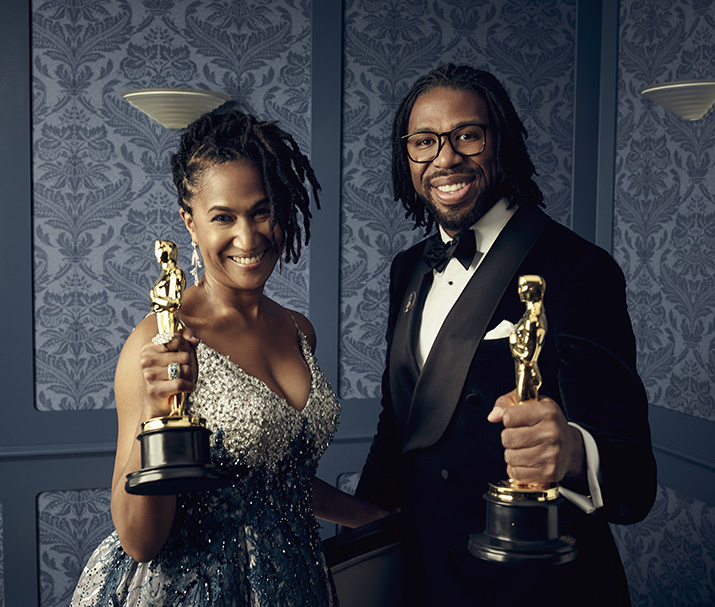
Oscar® winners Karen Rupert Toliver and Matthew A. Cherry at the 92nd Oscars® at Dolby Theatre® in Hollywood; credit AMPAS.
Since 1980, the population of People of Color has grown faster than Anglo-Americans. In a world where people have many alternatives to the cinema, talented People of Color are needed to better serve markets that were starving to see themselves and their stories represented with high production values as 3-dimensional characters.
RELATED: Black Oscar Winners & Nominees
Movie and TV program producers often choose actors and pay them according to Q Ratings that measure how well consumers recall and like a given actor. Q Ratings help determine the probability of a movie or TV program making a profit. After Bill Cosby, Shonda Rhimes was a black difference-maker for Q Ratings.
Shonda Rhimes award-winning, money-making success in producing Grey’s Anatomy, Scandal, and How to Get Away With Murder helped Channing Dungey become the first African-American president of ABC Entertainment Group. Dungey in turn, green-lighted more TV programming for People of Color, the springboard for many Hollywood careers. Competition with ABC influenced TV executives to hire more women and people of color in 3-dimensional dramatic, comedic, action and musical roles who would otherwise languish after 1 or 2 movies. As a result, Q Ratings increased enough to influence the inclusion of more black talent in big-budget movies.
The advent of Streaming (Netflix, Amazon Prime, Apple, Disney+, Hulu, HBO Max, Peacock, BET+) is forcing Hollywood studios and Cable TV channels to hire more black talent. Excluding the 2015 and 2016 Academy Awards “White-Out”, Oscar voters are growing more in line with Golden Globe voters, major guild voters, movie critics, and the movie-going public.
Denzel Washington does not have to carry the weight of “Black Hollywood” as Sidney Poitier did and Dorothy Dandridge was denied. Cicely Tyson, Forest Whitaker, Halle Berry, Angela Bassett, Jamie Foxx, Laurence Fishburne, Viola Davis, Will Smith, Terence Howard, Idris Elba, Taraji P. Henson, Jennifer Hudson, Cuba Gooding Jr., Octavia Spencer, Djimon Hounsou, Sanaa Lathan, Queen Latifah, Don Cheadle, Mahershala Ali, Zoe Saldana, Donald Glover, Chiwetel Ejiofor, Daniel Kaluuya, Sophie Okonedo, Chiwetel Ejiofor, Lupita Nyong’o, Jeffrey Wright, Regina Hall, Regina King, Morris Chestnut, Carmen Ejogo, Taye Diggs, Gabrielle Union, Gabourey Sidibe, Chadwick Boseman, Ruth Negga, Michael B. Jordan, and David Oyelowo have starred in movies that raked in guild nominations, awards, and high-profit ratios.
There are more black directors, writers, cinematographers, production designers, costumers, film editors, sound editors, assistant directors, and production assistants working than ever before. That virtuous cycle has led to a larger pool of movies produced, written, directed, and acted by people of color that attract more Oscar, Golden Globe, and cinema guild nominations.
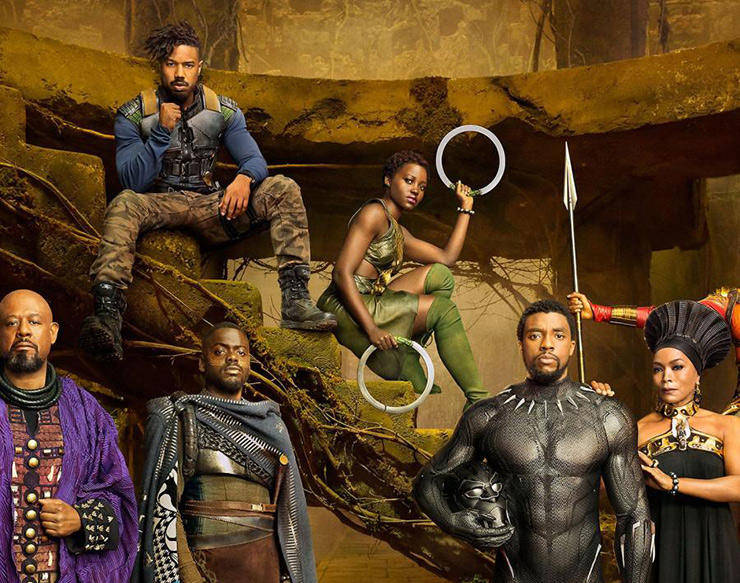
Black Panther movie released in 2018; credit Marvel Studios
Earlier, I mentioned that Hollywood cares most about big money-makers. Hollywood likes Denzel Washington because his movies rarely exceed $75 million cost and generate $100-266 million in cinema box office, plus substantial Broadcast, Cable, Streaming, Blu-ray & DVD revenue.
Hollywood studios loved Will Smith even more because many of his movies earned $300-$820 million per movie in box office from 1996 to 2008, plus significant Broadcast, Cable, Streaming, Blu-ray & DVD revenue while costing $100-200 million to make & promote. That size of profit pays many Hollywood salaries, including E TV channel and IMDB website which make money covering the Hollywood ecosystem.
If Disney Studios hadn’t seen Will Smith also generate large international box office, they would not have spent an epic-scale budget to produce the cinematic magic of Black Panther.
RELATED: Ruth Carter – Black Panther Costumer
In 2017, Jordan Peele’s Get Out cost only $5 million to produce and a couple million to market, yet made $255 million box office and most likely, $100 million in Broadcast, Cable, Streaming, Blu-ray & DVD revenue. With an amazing profit ratio on his resume, writer-director-actor Peele had no problem raising a $20 million budget for his next film, Us. It gets better.
Though 2018’s Black Panther movie won 3 Oscars, its financial success is the real story. From a $200 million production & $75 million marketing budget, it made $1.35 billion box office revenue. When Cable, Broadcast, Streaming, DVD & Blu-ray revenue are added Black Panther generated over $1.7 billion in total revenue. Hollywood studios now have more than Will Smith proof that big-budget movies starring black people CAN generate over $500 million in total revenue with $3 of revenue for $1 of production & marketing costs.
Black Panther drove up the Q Ratings for every featured actor in the movie. Two Creed movies costing a combined $85 million tallied $360 million box office also raised the Q Rating of Michael B. Jordan and the profile of writer-director-producer Ryan Coogler.
Spike Lee finally got some props. His 2019 Best Adapted Screenplay Oscar is shared with Kevin Willmott, Charlie Wachtel & David Rabinowitz. That is special for two reasons. Since Spike Lee opened more Hollywood feature film doors for black folks than anyone else, it was good to see him win on the “Big Stage.” Tangentially, it thanks movie directors before him like Gordon Parks, Melvin Van Peebles, Sidney Poitier, Charles Burnett, Michael Schultz, Euzhan Palcy, and Kevin Hooks. Spike has proven that he is true Auteur.
Further progress is needed in black-on-black romance movies and female salaries. The big picture, however, is that Hollywood trusts more black filmmakers in drama, comedy, sci-fi, horror, documentary, and action films. Hollywood is greenlighting more bio-pics anchored by black characters, whether directed by African-Americans or others.
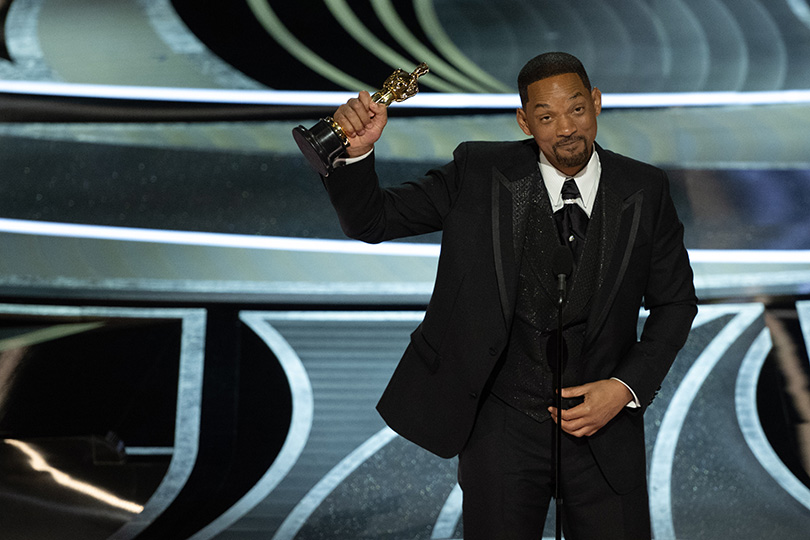
Will Smith wins the Oscar® for Best Actor at the 94th Oscars® at Dolby Theatre in Hollywood; (c) AMPAS
In closing, we should consider Will Packer in 2022. Though Tyler Perry is a movie mogul based in Atlanta, Black folks also need a next-level movie mogul in Hollywood. Will Packer is a magna cum laude graduate of Florida A&M University and holds a B.S. in Electrical Engineering. Will produced his first low-budget movie in 1994. With perseverance, Will expanded his portfolio to produce Ride Along 2, No Good Deed, Think Like a Man Too, Ride Along, Think Like a Man, Takers, Obsessed, Stomp the Yard and the mega-hit Straight Outta Compton.
As the first black producer of an all-black production of the Academy Awards Show, this was Will Packer’s moment to go next level up the Hollywood Mogul ladder. As his clout grows in Hollywood, it will accelerate stories by and about Women & Men of Color on the big screen.
The show’s three hosts hit their marks with aplomb. The stage sets were so incredible, they deserved awards. Academy Awards Show viewership was up compared to the prior year. The show was going very well until “The Slap” happened. That brings us to an unforgettable saying by Denzel Washington, “At your highest moment, be most careful. That’s when the devil comes for you.” Sadly, the Devil got ’em.
Having made a documentary about Black Hair, Chris Rock knew he was stepping on dynamite with that joke about Jada. He had to be nuts to insult her hair situation in front of a worldwide audience and her husband. Will Smith knew his Oscar was coming and the world was watching. He should have solved his beef with Chris Rock privately backstage.
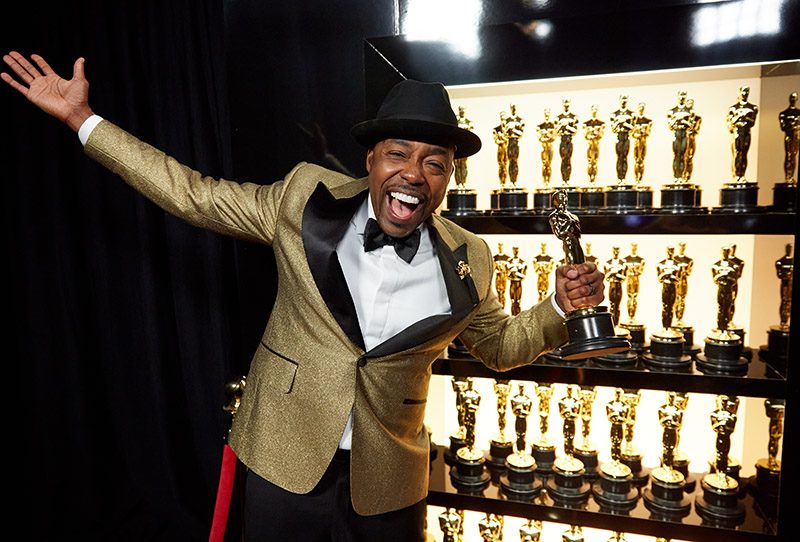
Will Packer, Lead Producer of the 94th Oscars® at the Dolby Theatre in Hollywood on March 27, 2022; (c) AMPAS
Instead, they pissed off millions of people, angered black women in particular, partially embarrassed Richard Williams, and stole the spotlight from a distinguished black movie producer. Both men should publicly apologize to Will Packer.
Newsflash. I did not think of the best solution to the Will Smith-Chris Rock situation. I hope that you also find it instructive to view the deconstruction of the situation and the best solution on Roland Martin Unfiltered.