Maryland’s Robust Underground Railroad Presence

Harriet Tubman Underground Railroad Visitor Center; credit Maryland Tourism

Discover a prideful experience at Harriet Tubman Underground Railroad Visitor Center; credit Maryland Tourism

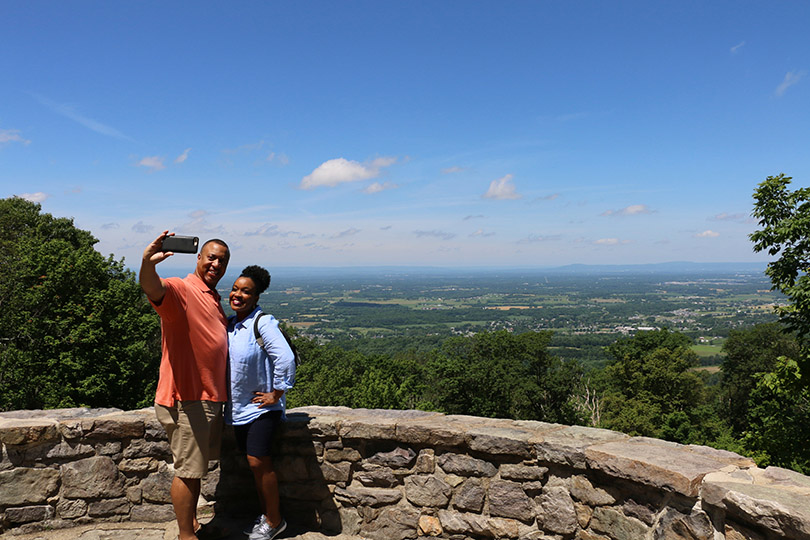
Maryland is filled with magnetic Underground Railroad (UGRR) experiences. Whether you’re drawn to UGRR sites in the mountainous West, former plantations in Central Maryland, Frederick Douglass’ formative UGRR milestones in Baltimore, or the Harriet Tubman Underground Railroad Visitor Center on the Eastern Shore, Maryland has a mother lode of sites for dignified reflection upon slavery and to celebrate triumphant journeys to freedom.

While exploring these historic sites, you’ll find amazing waterscapes, verdant fields populated with horses, and a bounty of interpretive centers.

Explore Western Maryland UGRR Sites

Several people fled northward and westward from Ellicott City, Frederick, Rockville, Washington, DC and Virginia for closer proximity to the free state of Pennsylvania. The C&O Canal and its towpath was used by freedom seekers as a route to Cumberland, where they were under 10 miles from the Pennsylvania border for a lesser chance at being caught. Some freedom seekers blended in with free Blacks and found employment on their UGRR journey to freedom.

Visitor centers in Cumberland, Williamsport and Great Falls feature many C&O Canal exhibits. Or, view the trail and towpath while a touring on a canal boat.

Kayak and Mercer ferry along the C&C Canal towpath; (c) Visit Maryland

Ride a Mercer canal boat as its pulled along the C&O Canal towpath; (c) Visit Maryland

The city of Hagerstown also played an important role with several buildings that were UGRR sites. People escaped from the Hollingsworth House and other nearby buildings in their journey to freedom. Download this brochure for an extensive walking tour of Hagerstown UGRR sites.

Western Maryland needed fewer enslaved people because mountainous terrain made it less agricultural. Instead, many of our enslaved and free ancestors worked as domestic servants or they worked at iron furnaces and forges. History buffs should consider a visit to Catoctin Iron Furnace Village in Frederick County. Miners, clerks, charcoal makers, storekeepers, teamsters and others worked under the iron master to produce metals from 1776 to 1905. Visit Museum of the Ironworker where archaeologists and the Smithsonian Institution created forensic facial reconstructions of people who were enslaved here. Numerous people fled from the iron works to freedom. Some names of people who escaped at different times include Peter, Gabriel, Phil, James Harry, and Len.

Their essential work preceded most Bethlehem Steel Company (1887-2012) operations in greater Baltimore. The Catoctin Furnace African-American Cemetery Interpretive Trail informs us more about their lives.

Catoctin Furnace site; (c) Visit Maryland

The historic Catoctin Furnace site where men of all stripes made iron; (c) Visit Maryland

Another must-visit is the Monocacy National Battlefield driving tour. On 9 July 1864, Union soldiers outnumbered three to one, fought gallantly along the banks of the Monocacy River to buy time for Union reinforcements to arrive in Washington, DC — saving the Capitol from Confederate capture. The battlefield is located three miles south of Frederick along the Georgetown Pike, today’s State Route 355.

Also on the driving tour, Best Farm comprises the southern 274 acres of what was originally a 748-acre plantation known as L’Hermitage, owned by Victoire Vincendière. The Vincendieres were the second largest enslavers in Frederick County, holding up to 90 people in bondage in 1800. A number of enslaved people fled from Best Farm, including Phil and Jerry who escaped within a month of each other in 1795.

UGRR Sites in the Capital Region

Historic Black communities in Montgomery County; (c) Visit Montgomery

Historic Black communities spawned from slavery in Montgomery County; (c) Visit Montgomery

Montgomery County is flush with 18th and 19th century UGRR sites. Gaithersburg was originally settled in 1765 as a small agricultural community. A Black community called Log Town became part of the larger town of Gaithersburg.

As such, Gaithersburg holds several historical sites and connections to significant events, including a slave revolt in 1845, which sparked the Battle of Log Town. The conflict was between the Rockville militia of citizens, and a large group of freedom seekers from Southern Maryland who were caught traveling north on Rockville Pike. Most of the freedom seekers were captured and sent to the Montgomery County Jail in Rockville. A few freedom seekers escaped the conflict and made it to freedom.

Bohrer Park at Summit Hall Farm is adjacent to the Log Town battle site. Bohrer Park sits on a large tobacco plantation and includes the Summit Hall Farm with its fully restored farm house. People living at Summit Hall would have witnessed the Battle of Log Town.

Woodlawn Manor Cultural Park; (c) Visit Montgomery

Woodlawn Manor Cultural Park & Museum in Sandy Spring; (c) Visit Montgomery

A tad east in Sandy Spring, the sylvan setting of Woodlawn Manor Cultural Park is juxtaposed between the large metro areas of Baltimore and Washington. Its Museum, Horse Stable, Stone Barn and lengthy UGRR Experience Trail evoke strong emotions. The museum describes the role of Quakers who settled Sandy Spring in opposing slavery and assisting freedom seekers in this area.

When sitting still at a place along the harrowing UGRR Trail, however, you can discover joy knowing that ancestors traveled this path to freedom.

The Bealls of Rockville were one of the largest slave-owning families in Montgomery County. Upton Beall, a wealthy landowner had slaves work here at his city house, mills on Watts Branch, and his rural property Beallmont. On their 67-acre Rockville parcel, about 40 slaves, including John Henson, Josiah Henson’s brother, worked the land, cooked, cleaned, tended kitchen gardens, canned, washed, ironed, and cared for livestock. Some fled to freedom.

Visit Josiah Henson Museum & Park for a self-guided tour of interactive exhibits and artifacts across the property that tell the life story of Reverend Josiah Henson, slavery in Maryland, and the ongoing struggle for racial equality. In 1850, Jane Beall sold John Henson to Josiah Henson for $250. It is presumed that John is the brother that Josiah mentions purchasing from Maryland in his autobiography.

Josiah Henson Museum

Tribute actors at Josiah Henson Museum located between Bethesda and Rockville, MD; (c) Visit Maryland

The majority of the Beall slaves were housed in three slave quarters on the different properties. You can take the Forging Freedom Self-guided Walking Tour in Rockville, including the red-brick Beall-Dawson House. In that house, enslaved people likely lived above the kitchen, where they had rooms with windows and fireplaces. Field slaves at the Rockville property likely lived in quarters at the north edge of the property near Martins Lane.

In 1862, the Beall Sisters freed 17 of their slaves who worked in Washington, DC and received $9400 via a federal compensation program. The rest were freed when emancipation was granted in Maryland on 1 November 1864.

Beall-Dawson House in Rockville; (c) Visit Maryland

The Beall-Dawson House in Rockville; (c) Visit Maryland

Today, you can see small parcels the Bealls land sold to the freed slaves along nearby Martins Lane and Middle Lane — two of Rockville’s Black neighborhoods.

Immerse Yourself in Central Maryland UGRR Sites & Museums

Baltimore has a wealth of Underground Railroad sites and museums that help interpret this history. Visitors may find sites such as Orchard Street Church and other historic churches to be powerful reflections of Baltimore’s role in this legacy. At Orchard Street, visitors can see a space that church historians speculate could have been used as a hiding place for freedom seekers and possibly a connection to other local sites. Oral histories tell us that freedom seekers escaping from nearby plantations such as Dorsey Plantation and Hampton Plantation may have found refuge at Orchard Street.

Orchard Street Church in Baltimore; (c) Soul Of America

Orchard Street Church in Baltimore; (c) Soul Of America

Visit Baltimore’s Reginald Lewis Museum of Maryland African American History & Culture, Frederick Douglass-Isaac Myers Maritime Park & Museum, and the National Great Blacks in Museum for visceral interpretation of Maryland’s role in the journey to freedom.

The Baltimore & Ohio Railroad Museum at Mount Clare Station is more than a great attraction with fully restored 19th-century trains. Many people fled to freedom on the B&O Railroad and passed through Mount Clare Station. As the Birthplace of American Railroading in 1827, the B&O Railroad inspired various aspects of the UGRR, including coded language inspired by its railroad terminology. This is most likely where words like “conductor” to describe UGRR agents and “station” to describe safe havens originated.

Old trains in the B&O Railroad Museum ; (c) Soul Of America

Old trains encircling the roundhouse perimeter within B&O Railroad Museum; (c) Soul Of America

Historic figures like Henry “Box” Brown and William and Ellen Craft traveled the B&O Railroad from Washington, DC to Mount Clare Station. The B&O Railroad Museum earned its listing on the National Underground Railroad Network and has an interactive exhibit of stories about those freedom seekers.

Baltimore’s Inner Harbor also contains a vessel important to the lives of many freed from bondage. The U.S.S. Constellation was used to intercept the illegal trans-Atlantic slave trade after it was outlawed. The ship is fully restored and open to tour. See https://www.visitmaryland.org/baltimore-inner-harbor-fells-point-underground-railroad-walking-tour for more detail.

U.S.S. Constellation in Baltimore Inner Harbor

The U.S.S. Constellation docked in Baltimore Inner Harbor; (c) Soul Of America

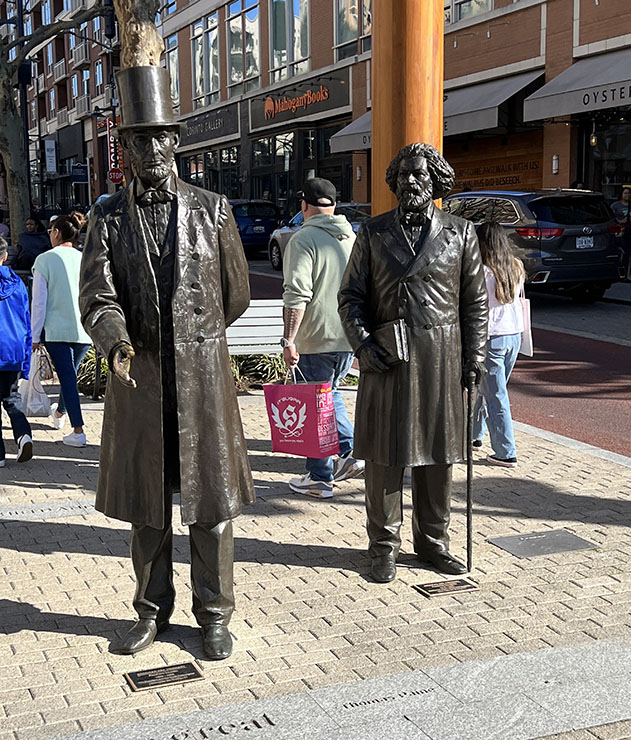
You can also visit several Baltimore sites related to the Great Abolitionist, Frederick Douglass (1818-1895). In the Fells Point district of Baltimore, Douglass spent much his youth learning to read, speaking up, and rebelling against slavery. In 1833, Douglass was sent to a vicious enslaver to “break him” in St. Michael’s, a town in Maryland’s Eastern Shore.

Unbroken, Douglass fought his enslaver in 1834. He was never whipped again. In 1836, Douglas was sent to another enslaver in Baltimore. He managed to learn a caulking trade on the waterfront and met his future wife Anna Murray, a free daughter of slaves.

In 1838, Douglass escaped to the free state of New York. By developing great oratory skills as an abolitionist, Douglass attracted like-minded friends in the North and Europe. In 1846, his manumission papers were filed and freedom was purchased in Baltimore by British friends.

More than any other state, Maryland provided the foundational experiences for Frederick Douglass to become Station Master at the Rochester, NY UGRR terminus, helping hundreds follow the North Star to freedom.

Frederick Douglass tribute actor

Frederick Douglass tribute actor in front of one of his Fells Point houses; (c) Soul Of America

Later in life, Frederick Douglass also had the sweet reward of purchasing row houses at 516–524 South Dallas Street, on the site of a former church he attended as a child in Fells Point. Today, you can see but not enter those private residences.

UGRR Sites Eastern Shore

There’s no better place to dive into the heroic legacy of Harriet Tubman than Maryland’s Eastern Shore. Visit her birthplace, discover her remarkable story, and follow in her brave footsteps along the Harriet Tubman Underground Railroad Scenic Byway.

Though its history is painful at times, Maryland residents are proud of our their great resilient state. It’s a spellbinding, full measure of the Black Experience in America, including a Black Governor to be proud of. Make Maryland yours too.

WEBSITE: https://www.visitmaryland.org
PHONE: 877-333-4455
Return to BALTIMORE

Return to ANNAPOLIS

0 replies

Login. Register. Use your Google / Facebook login.

Leave a Reply