About Soul Of America

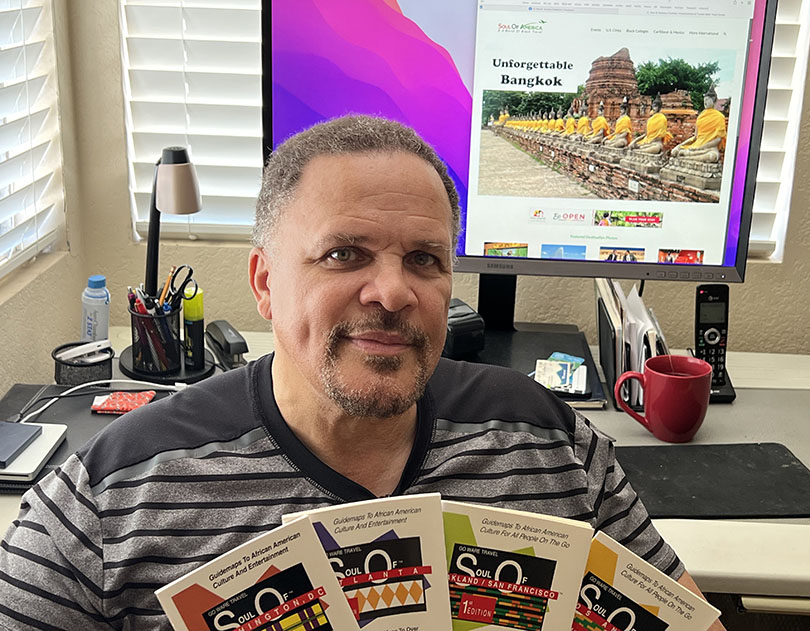
Thomas Dorsey, founder of Soul Of City Maps with SoulOfAmerica.com website in the background
The Soul Of America origin story begins with ancestors who paved the way. The first Sleeping Car Porters were hired by the Pullman Company shortly after the Civil War ended in 1865. George Pullman recruited formerly enslaved Black men to work as porters on his luxurious sleeping cars, believing they would accompany high-quality service with a “servile demeanor” expected by wealthy white passengers.

A proud Pullman Porter
By necessity in the hazardous Jim Crow Era, Sleeping Car Porters created address lists of safe places to eat, drink & lodge for each city they visited. Though their lists were informal and non-commercial, Pullman Porters were effectively the First Black Travel Publishers.
In 1936, Victor Green’s eponymous Negro Motorist Green Book upgraded and commercialized that content for a national market. Each edition of the Green Book up to 1966 helped Black travelers better navigate segregated America as highways improved and cities grew.
Today’s vibrant and multifaceted ecosystem of Black Travel cntent stands on the shoulders of those giants — Sleeping Car Porters and Victor Green.
In the 1950s, my granddad became the First Black Teamster in Maryland and used the Green Book on interstate trucking journeys. My dad and his friends used the Green Book while driving coast-to-coast twice, since they had to know where their stops were welcome.
In the 1970s, Thomas Dorsey took Black History classes at a high school in Baltimore and the University of Pittsburgh. At Pitt, I joined the Hound Phi Hound social club and became the sound technician for 3 years at Kuntu Repertory Theatre under Dr. Vernell Lillie, principally featuring plays by Rob Penny and August Wilson.
In the 1980s, I was a member of the Northern California Black Professional Engineers who worked for Hewlett-Packard and leisure traveled to 20+ U.S. cities. That background intensified my reverence for Black culture and travel.
I felt honored that my young niece, nephew & cousins allowed me to take them to the Smithsonian Museums in DC. I was soon disturbed by one exhibit that misled visitors to believe that Ancient Egyptians were Mediterranean people rather than African.
Based on over 3000 years of facts before the Greeks arrived, I convinced the Museum director to shut it down immediately and correct it for reopening, which was many months later.
In 1990, there were only a handful of travel guidebooks that listed a few black heritage sites in New York City and Washington. One guidebook series that Thomas purchased advised people, excluding the U. of Chicago area, NOT to visit the South Side of Chicago.
Given my background and amazing South Side visits, it disturbed me. Just before sending a written letter to the publisher, I round-filed it and challenged myself to publish something better.
During my last semester at UCLA Business School in 1991, I wrote a draft business plan to publish Black Travel Guides. To evolve the draft into a realistic business plan, I did initial market research at the Los Angeles Central Library, but knew that he also needed statistically significant surveys for in-depth market research.

To attract survey takers, he created The Soul Of Hollywood T-shirt listing Black stars on the Hollywood Walk of Fame. He asked a college friend, Tracy Ellis, to join him on Hollywood Boulevard, giving out T-shirts and asking Black travelers to complete a survey of what they wanted in travel guides. We gave out 100 T-shirts and collected nearly 1000 surveys.
I learned the content desired and the city guides to publish first. However, I’d yet to decide on the print format and had insufficient data on product price, distribution, and promotion at that time. Just after Spring 1991 graduation, I became a computer software product manager in LA. and explored more of the entertainment capital.
I returned to the San Francisco Bay Area in the fall of 1992 as a computer product manager. Though busy in my corporate job, I named the moonlight venture “Go Ware Travel” because, like many at that time, he thought CD-ROM would join Print as a dominant publishing media. In 1992, I decided that the initial branding would be “Go Ware Travel Soul Of ______” for each city guide.
I wasn’t the only one opening new vistas in Black Travel. Festival At Sea began its first cruise of 250 patrons in 1992. There were a handful of established Black Travel agencies booking group trips to Africa and Europe as well.
After marriage and buying his first home, I taught myself how to create digital maps of districts important to Black Travelers and pinpoint sites within them. Additional features of the first city guide include a system design by artist Kenneth Williams and a folded layout co-developed by Vickie Robins & me. The result would be an innovative guide map of easy-to-find, color-coded Black heritage, culture, dining & entertainment sites.

Soul Of Los Angeles Guide Map — Side 1 Layout
In July 1994, I published Go Ware Travel’s color-coded, 2-sided, fold-up Soul Of Los Angeles Map. In December 1994, I published Go Ware Travel’s Soul Of Oakland-San Francisco Map on heavier paper stock with a design refinement to contain 10% more content. I sold them in select Black bookstores, art galleries, nightclubs, social events, trade shows, and festivals.
Black Meetings & Tourism Magazine, founded in 1994, also deserves props for helping more Blacks succeed in the national conventions market.
In 1995, while keeping my day job, I refined the Go Ware Travel Soul Of Atlanta and Go Ware Travel Soul Of Washington DC guide map to have better quality photos and a superior fold that’s easy to handle on the go. Customers loved their Look & Feel for use and gifting. In one of my favorite compliments, a tourism executive called our new guide maps “Interactive.”

Soul Of Washington, DC Guide Map — Side 1 Layout
Though I knew 2nd edition Soul Of Los Angeles and Soul Of Oakland-San Francisco guide maps needed the same Look & Feel, a national publishing distributor was impressed enough to distribute all our guide maps to Barnes & Noble, and Borders in LA, San Francisco Bay Area, Atlanta, and Washington. I was invited to speak about them at several bookstores and Black conventions.
When placed on bookstore counters in January-March, our guide maps sold fast. Nevertheless, sales revenue was still disappointing because most bookstores failed to display them or placed them behind Rand McNally maps. I had to find another distribution channel, so I approached the big dog online.
Though the first public Web browser debuted in November 1994, subscription-based AOL was the “Online Content King”. Despite several attempts over 1995-96, I could not reach a digital distribution deal with AOL.

Go Ware Travel Soul Of City Guide Map Series
Fortunately, in 1996, I convinced a corporation to sponsor a Soul Of Dallas mini-map that I handed out at the Black MBA convention. That revenue helped our next stage of growth.
There was no proven way to generate significant ad revenue on the Web until mid-1996. Even then, only a couple of Black-oriented websites, NetNoir and BlackVoices, had enough traffic and business connections to attract ads. I placed our first ad on NetNoir to promote our guide map series. Unfortunately, the ad was buried 10 levels down and underperformed as a promotion outlet for direct sales. I was disturbed again.
I decided to develop a simple website to promote the guide maps since Web traffic, in general, was growing exponentially. While developing Go Ware Travel Soul Of Chicago and Soul Of Los Angeles 2nd edition in 1996, our map fans requested more content per city and to place our city guide map content on the Web.
Chicago and Los Angeles guide map designs were completed, but I made the difficult decision to stop before printing, build a content website, and fund travel research to more cities. On the East Coast, my brother Lenny did more research in Baltimore, Washington, and Philadelphia.
In March 1997, Thomas converted & expanded our content into travel guides for Los Angeles, Chicago, Atlanta, Washington, New York City, Baltimore, San Francisco-Oakland, New Orleans, Philadelphia, Detroit, Dallas, and Houston on GoWare-Travel.com. That Web leap cannibalized our city guide map sales until I could develop an advertiser-driven business model years later.
The benefits of online publishing proved far greater than my company alone. As the 1st Black Travel Content Website, we gave thousands of Black churches, historic sites, cultural sites, and businesses their first Web presence.
Also that year, Elaine Lee published Go Girl: The Black Woman’s Book of Travel and Adventure. That seminal guide for a Black Woman’s independent international travel was a guidepost for many Black Travel Vloggers today.
I had bigger plans online. As an Internet Travel pioneer preceding TripAdvisor and Yelp, however, there was NO Venture Capital for a start-up Black Travel Website. I was told by many VCs that they needed to see Net Noir and Black Voices succeed before investing in another Black Internet company. Every other Black Internet company I met heard the same “NO.” Draw your own conclusions.
In April 1998, I renamed the company “Soul Of America Travel”, initiated the Soul Of America DBA, and upgraded the SoulOfAmerica.com website. Soon afterward, Sheila Umolu and others joined our team with energy and ideas that expanded content for more cities, Black Colleges, beaches, Black tour guides, and Black Towns.

SoulOfAmerica.com Home Page July 2001
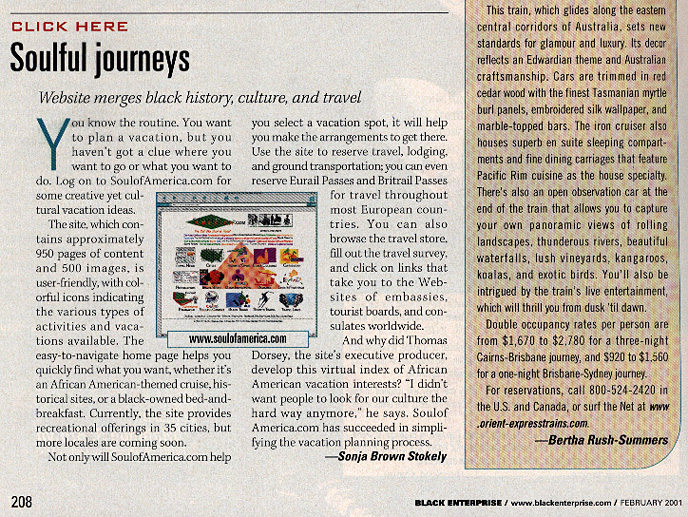
Our second, and much larger ad, was placed in Black Enterprise magazine. After being featured in Ebony, Upscale, Essence, Black Enterprise, and Emerge magazines, BET, NPR, Associated Press, USA Today, New York Times, Los Angeles Times, San Francisco Chronicle, Atlanta Journal-Constitution, Baltimore Sun, and dozens of Black newspapers, our fan mail and bookmarks multiplied.
In 2000, Soul Of America hosted the first Black Travel Writers Cruise and had the pre-cruise event hosted by the first Black-owned hotel on Miami Beach.
I became a full-time publisher in 2001. To stay connected with fan requests, my team and I rented booths at Black conventions. We attended museum & cultural events in Oakland, San Francisco, Los Angeles, NYC, Brooklyn, Atlanta, Miami, New Orleans, Detroit, Dallas, Houston, Cincinnati, St. Louis, Cleveland, Pittsburgh, Washington, Chicago, Philadelphia, Memphis, and Baltimore.
For many years, I ran a free Home Page ad asking fans to donate to the National Museum of African American History & Culture building fund.

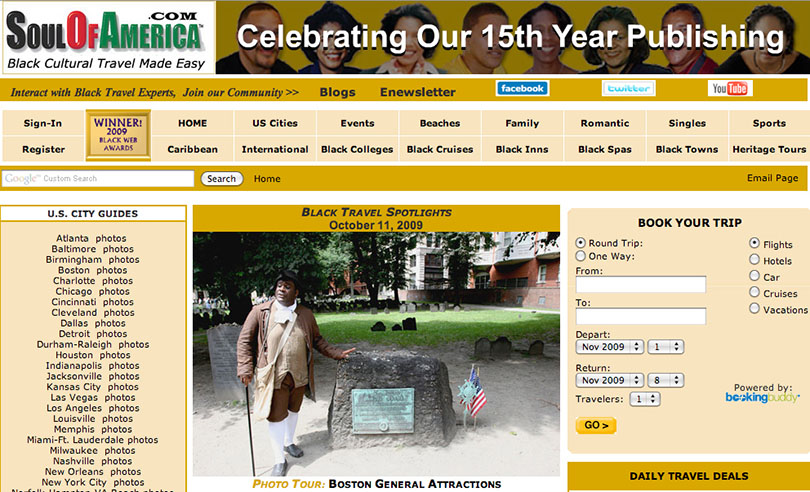
In 2009, SoulOfAmerica celebrated 15 combined years of publishing maps and a travel website
Fans requested Black Travel guides for more U.S. Cities, the Caribbean, Canada, and Mexico. Delivering on fan requests also led us to guides for destinations in Europe, Africa, and Asia. Fans rewarded us with votes to win 4 Black Web Awards in the 2000s.
In our amazing journey to 150+ travel guides, many other Black-owned websites have come and gone. Though we’ve had enough IT, Google, hacker, and advertiser challenges to make an onion cry, the SoulOfAmerica.com website survived through our grit and determination.
Soul Of America takes pride in being a pioneer that helped grow the Black Travel Ecosystem. As a member of the Black Travel Alliance and Blacks in Travel & Tourism, we make Black Travel Matter in the digital and real world.