
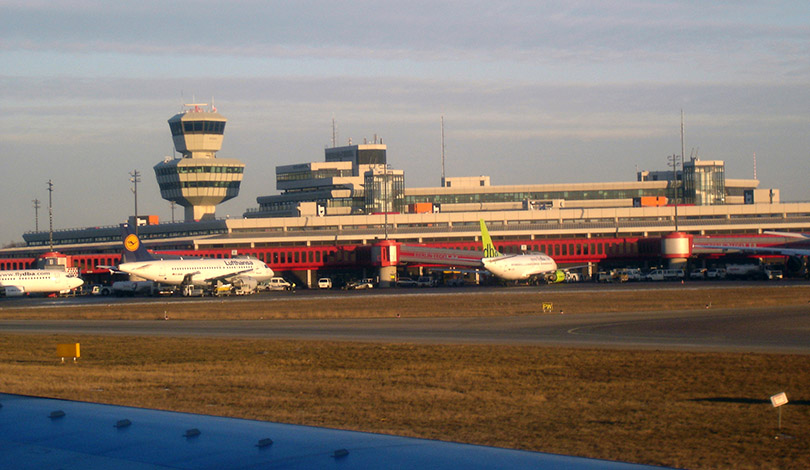
Large scale International airplanes at Berlin Tegel Airport
Berlin Transportation
Airports
Berlin Tegel Airport (TXL), hosts over 50 airlines, including United. A major historic site, Tegel is a former Nazi Air Force base where the world’s first jet aircraft was created. Today, Tegel Airport serves over 20 million annual passengers. It operates frequent TXL JetExpressBus to Alexanderplatz, Brandenburger Tor, and Hauptbahnhof U-Bahn Metro stations. BERLIN TEGEL AIRPORT MAP
Berlin-Schonefeld Airport (SXF) hosts nearly 30 airlines and with annual patronage around 7 million. Also having excellent ground transportation options, Berlin-Schonefeld features S-Bahn Regional Rail trains to Berlin Hauptbahnhof for connection with ICE high-speed trains. BERLIN-SCHONEFELD AIRPORT MAP.
Check the luggage policy for your airline and confirm your flight 24 hours in advance. Make a copy of your passport/flight/hotel itinerary and leave it with someone at home. Pack headache and other medicines in your hand luggage. There is free WiFi through the airport. Taxis and shuttle buses await you at the Arrivals roadway.
Train Stations
Berlin Hauptbahnhof (Berlin Central Station) became the main railway station when it opened in 2006 on the historic site of Lehrter Bahnhof railway opened in 1871. The massive Berlin Hauptbahnhof hosts 17 ICE intercity trains, 12 regional trains, and a massive shopping mall.
Opened in 1842 and rebuilt several times, Berlin Ostbahnhof was the central train station from 1987 to 1998. The Berlin Wall ran only 200 meters away from it. Today, the station has 9 platforms to board trains. Though a number of ICE trains were transferred to Berlin Hauptbahnhof, Ostbahnhof remains an important station. If traveling by train to other parts of Germany, Ostbahnhof may be a better option.
Berlin Lichtenberg is a railway station and rapid transit station. Since 2006, most international trains to Eastern Europe used to stop at Berlin-Lichtenberg Station. Now, night trains from all parts of Germany terminate at Berlin Hauptbahnhof. Lichtenberg Station was featured in the opening scene of The Bourne Ultimatum movie, where it was disguised to look like a Moscow train station.
It’s popular for tourists to fly into Berlin, then ride 143-186 mph ICE trains from Berlin Hauptbahnhof to Wolfsburg, Hanover, Hamburg, Leipzig, Erfurt, and Frankfurt. By 2026, ICE system will connect more German cities in 3 hours or less from Berlin.
Rapid Transit
In Berlin, one of two Metro systems is the 94-mile U-Bahn, featuring 10 lines spreading across Berlin. U-Bahn does not have station turnstiles. Use platform machines to buy your destination ticket. When you purchase your ticket, carry it on the U-Bahn train. A conductor walks through each train car and asks for your ticket. If you forgot to buy a ticket, expect the Gestapo treatment. Actually, the conductor will give you a chance, if you look and act like a well-mannered foreign visitor.
Other than the yellow color, Transit trains look the same as most transit trains in America. This should come as no surprise since German companies manufacture many of the world’s transit vehicles.
The U-Bahn Reichstag Station was used to shoot scenes of the movies Resident Evil and Equilibrium. Since 2001, Berlin U-Bahn has hosted the annual short-film festival, Going Underground. Short films are shown on the monitors on many U-Bahn trains. Passengers on board vote for the festival winner.
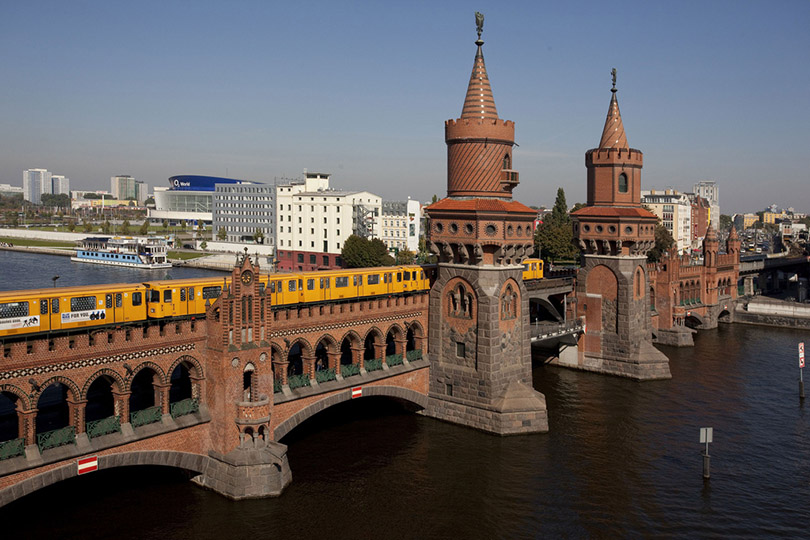
U-Bahn train crossing Oberbaumbrucke bridge over Spree River, Berlin; credit VisitBerlin
The S-Bahn is the second electric rapid transit system consisting of 15 lines running 206 miles to 166 stations in metro Berlin. It only carries about 75% as many passengers as the U-Bahn. Although the S-Bahn and U-Bahn have different operators and most of the S-Bahn is surface, they share a unified fare system. And unlike the U-Bahn, the S-Bahn crosses the Berlin city and state border into the surrounding state of Brandenburg or Potsdam.
View this BERLIN U-BAHN & S-BAHN SYSTEM MAP.
Like Metrorail systems worldwide, prevent being targeted by pickpockets as a vulnerable tourist. If traveling alone, avoid reading paper maps or tourist books on the Underground. Instead, study the Underground map on your computer/tablet in your hotel room or at a cafe. If you have questions about the Metro, ask the concierge or English-speaking waiting and tip them. Then fold and stash away paper maps. Then after catching the Metro, a brief glance at maps in stations and on trains will not draw undue attention.
Berlin has an extensive Tram (Light Rail) System running on streets that complement the U-Bahn and S-Bahn systems. Consider short rides on M1, M5, and M12 Trams to reach more attractions and interact with German residents.
Together, the Berlin U-Bahn, S-Bahn, and Trams form a comprehensive rapid transit system that transports half as many people as the NYC Metro Subway system.
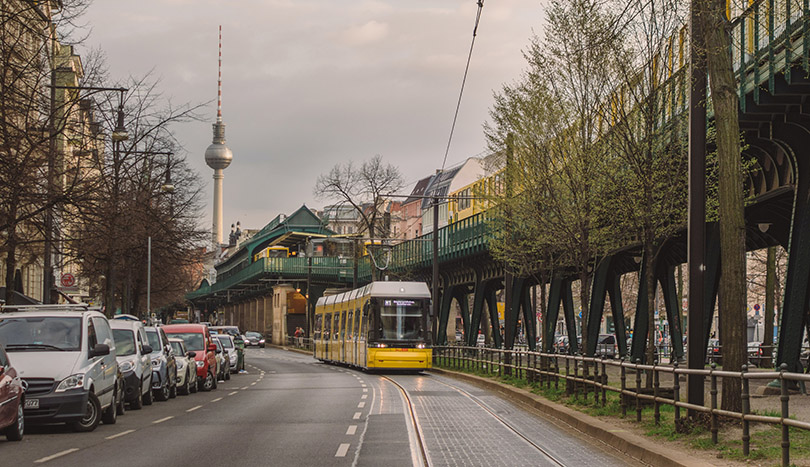
One Tram vehicles of many in an extensive system leaving a Berlin U-Bahn station; credit FionnGroße
Autobahn
Germany is home to the Autobahn, the father of what we call freeways and expressways in America. U.S. Interstate Highway System was designed on the same principles as the Autobahn: high-speed, controlled access highways used for personal, commercial, and military vehicles. Like Americans, Germans drive on the right side of the Autobahn.
Provided weather, no roadwork, and traffic conditions align to permit, the Autobahn has sections without a speed limit. Wherever you see speed limit signs, OBEY them. If you’d like to drive 100-120 mph on the Autobahn, we recommend that you rent an Audi, Volvo, or BMW. Stay in the right lane. If you have to pass a vehicle only do so from the middle lane.
Otherwise, you might find a 175-200 mph sports car breathing down your back.
This video illustrates how fast cars can travel in the left lane of no-speed-limit Autobahn sections that have 3 lanes on each side. Drivers in the right lane and middle lane are likely doing 100-120 mph. A 700 hundred horsepower Lamborghini racing up to 200 mph in the left lane will either thrill you or raise hair raise on the back of your neck.